
I stepped into one of the worst-performing locations in a 60+ unit full-service chain as General Manager. Full P&L. Four managers. Forty-plus staff. A dining room in suburban Orange County that looked fine from the outside, and a business that was being financially carried by the rest of the chain.
I came in the way most operators come in. With conviction.
Bring energy. Build culture. Get busier. Coach the team. The numbers will follow.
For two months, that's exactly what I did. And the numbers didn't move.
Labor: still 39-41%. Food cost: still drifting at 38-40%. Turnover: near 90%.
I was coaching harder, leading longer shifts, staying later. I was doing everything the industry tells you to do when a location is underperforming. And nothing was changing.
At my third monthly review, my Regional Manager made it clear: if this doesn't turn around, you won't be here much longer. And possibly, neither will the restaurant.
Driving home that night, the quietest, most destructive thought crept in: "Maybe I'm just not good enough for this."
That's the thought operators don't say out loud. The one that sits underneath the long hours, the short patience, the habits that were supposed to take the edge off. You still show up. You still perform. But underneath it, something is eroding.
If you've been there, you know exactly what that feels like.
The Shift
The problem was never effort.
It was architecture.
That night, I couldn't sleep. I kept replaying every report, every "everything's good" from my managers, every number that should have moved but didn't. And a question formed that changed everything: what if the operation I thought I was running wasn't the operation that actually existed?
The next morning, I stopped managing and started observing. Not coaching, not leading. Just watching.
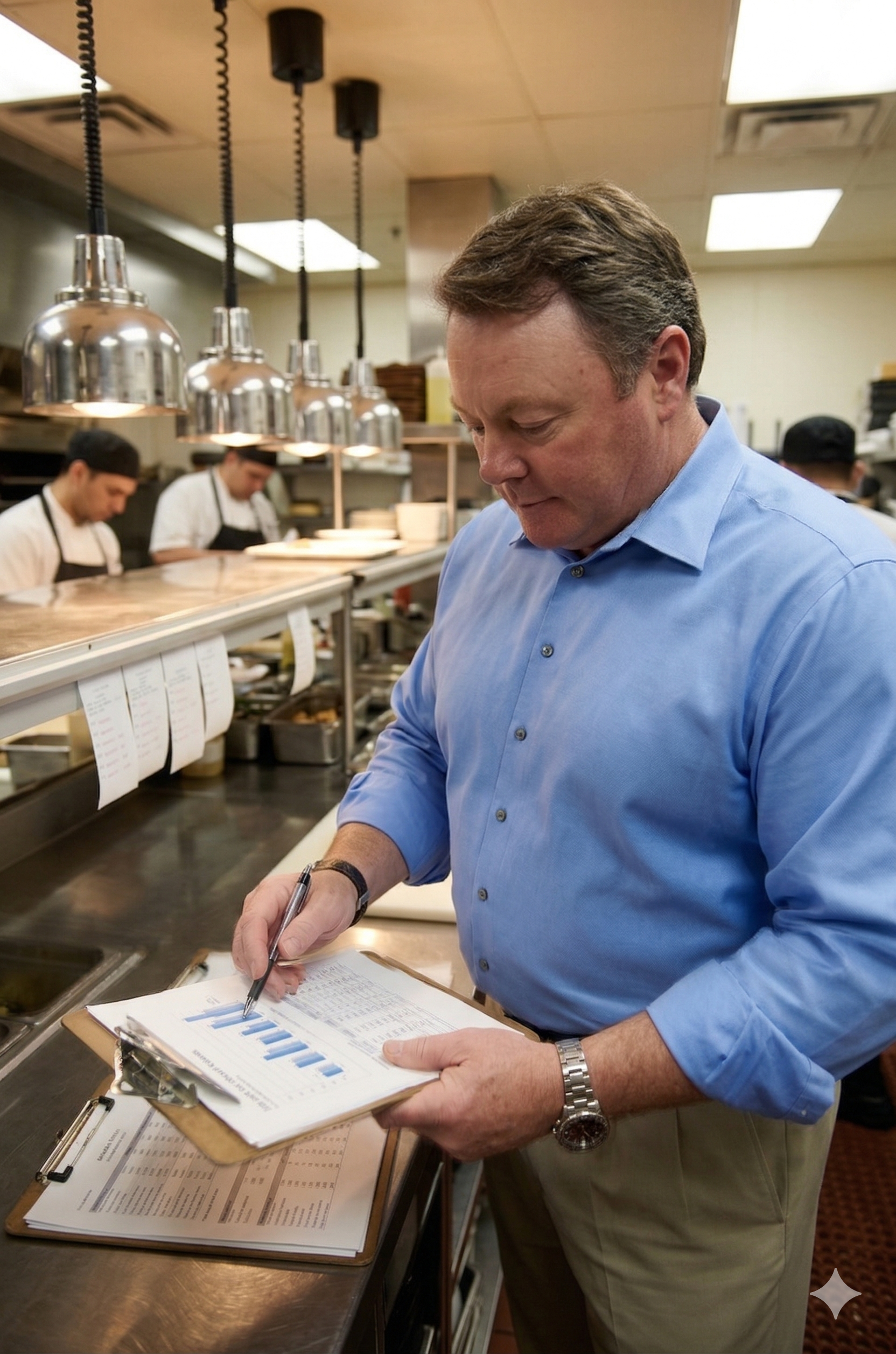
What I found in one shift was staggering. Received orders signed off without being checked. Prep trim above standard. Preportioned items not weighed. A waste log that hadn't been touched honestly in weeks. Managers filling out checklists at the podium without walking the floor. Servers eating off the line without ringing it in. Refires that never hit the POS. Cooking errors that disappeared. Comped drinks with no record.
A hundred small lapses. None of them dramatic on their own. But stacked across every shift, every day, every week, they told a completely different story than the one showing up on the P&L. Two versions of the same restaurant. One real. One reported.
The staff weren't broken. The visibility was broken.
So I stopped trying to motivate performance. I started installing architecture.
Daypart labor targets. Cover-per-hour tracking. Cut thresholds. Portion verification logs. Waste transparency. A server training I called The Perfect Check — disciplined sequencing that didn't add a single step to the job, just intention to every table.
The Proof
Same team. Different structure. Different numbers.
41%→37%
Labor - Week One
40%→30%
Food Cost - 60 Days
#62→#3
Chain Ranking - 6 Months
6
Locations Turned
Within one week of installing daypart labor targets and cut thresholds, labor dropped from 41% to 37%. Within 60 days, food cost dropped from 40% to 30%. Within six months, that location moved from second-to-last in the entire chain to third overall.
Regional leadership began moving me to struggling units. Over two years, I turned around six locations. Some of the systems I built were adopted chainwide.
Server check averages climbed 18% team-wide, with top performers hitting 25%. Turnover dropped from 90% to 65%. Not because the team changed. Because the structure around them changed.
"The restaurant got quieter. Not slower. Quieter. Calmer. When thresholds are visible, you don't panic. When accountability is built into the system, you don't yell. You just adjust."
The pushback I expected never really came. Once the team understood what I'd seen and why it mattered, once the retraining was done with respect and not blame, they stepped up. The culture actually improved. Tensions lifted. People got better at their jobs because the structure around them made it possible to be good.
I was more proud of my staff making that turnaround than I was of myself. They did the work. I just kept nudging them in the right direction.
That's when I stopped thinking of this as a skill. And started recognizing it as a model. Not personality. Not charisma. Not a one-time save. A repeatable, installable model.
And if it was repeatable, it could be built into your operation.
Why This Exists
The Knife. The Ledger.
The discipline between them.
The knife is the obvious symbol of the kitchen, the craft, the execution side of what you've built. But it's also about cutting through what isn't working. Getting to the heart of what's actually happening in your operation, without the noise, without the performance, without the comfortable stories we tell ourselves when the numbers don't add up.
The ledger is the accountability. The clarity. The structural discipline an operation has to live by to be successful. Not spreadsheets for the sake of data. Visibility that changes behavior.
Together, they represent what most restaurants are missing: precision in execution, paired with financial and operational discipline.

The vision for Knife & Ledger had been building for nearly a decade, ever since I left the industry and started seeing the same patterns from the outside that I'd spent years correcting from the inside. The same structural gaps. The same misdiagnoses. The same operators carrying weight that should have been carried by systems.
In January 2026, I stopped watching and started building.
Not a consulting firm. Not a coaching program. An operational architecture practice. Built from the conviction that most restaurant owners aren't failing because they don't care. They're failing because they're running on visibility they don't actually have. And looking closely at the numbers feels either overwhelming or threatening, so they delay, or push harder, or convince themselves that more revenue will solve it.
It won't. More volume amplifies drift. It doesn't correct it.
Your feed is full of people selling the one thing that'll fix everything. Better Google listings. A packed reservation book. One magic food cost number. And they're not all wrong. But they're solving pieces without seeing the whole picture. Shaving a point off labor doesn't matter if your waste is invisible. Filling every seat doesn't matter if your busiest night is your least profitable.
It doesn't take mountains of new technology to make your restaurant profitable. You just have to pay attention to the things that are quietly bleeding you dry. Get your head out of the pass and start observing the behaviors that are driving the loss.
The structure underneath you
either holds weight or it doesn't.
If it doesn't, working harder won't change that. But building differently will.
Start with the free Busy But Broke Breakdown. Pick one shift, answer ten questions, and see whether your busiest night was actually your most profitable. If you want to go deeper, we'll talk about what that looks like.
Or, if you're ready to talk: Book a Discovery Call →