
Let's Talk About What's Actually Happening Inside Your Operation.
There's a number on your P&L right now that doesn't match what you expected.
Maybe it's labor. Maybe it's food cost. Maybe it's the quiet suspicion that your best quarter still didn't feel like it should have.
You're busy. The dining room is moving. The team is there. And somehow, the margin still isn't where it needs to be.
Nearly every owner I've worked with has been in that exact position. Most operators at this stage do one of three things. They push harder. They hire better. Or they convince themselves the answer is more volume. More tables, more marketing, more traffic through the door.
And deep down, if you're honest with yourself right now, you already know that.
If I Can Get You to Believe One Thing Today, Just One, Let It Be This.
The gap between where your operation is and where it needs to be is not a hustle gap. It's not a marketing gap. It's not a staffing gap. It's a structure gap. And structure can be installed in 30 days.
That's it. That's the entire premise of everything you're about to read.
Not a dozen things to fix. Not a system overhaul that takes a year. Not a new hire or a new concept.
One gap. One type of gap. And a specific, sequenced, 30-day method for closing it.
Let me show you exactly how I know it's true.
While You're Holding That Thought, the Drift Is Compounding.
Now hold that thought. Because while you're holding it, something else is happening inside your operation right now.
Labor's off. Food cost won't stay consistent. The operation's bottlenecked through one person. Every week the structure stays uninstalled, those patterns compound. Not because you failed. Because the architecture was never built.
The question isn't whether you can afford to fix it.
It's how much longer you can afford not to.
Your Feed Is Full of People Selling the One Thing That'll Fix Everything.
Better Google listings. A packed reservation book. One magic food cost number. And they're not all wrong. But none of it fixed the problem either.
Because shaving a point off labor doesn't matter if your waste is invisible. Filling every seat doesn't matter if your busiest night is your least profitable. Renegotiating with your vendor doesn't matter if your prep team is throwing away what you saved.
They're solving pieces without seeing the whole picture.
It doesn't take mountains of new technology to make your restaurant profitable. You just have to pay attention to the things that are quietly bleeding you dry.
Get your head out of the pass and start observing the behaviors that are driving the loss.
The answer was never one fix. It was learning to see the whole picture. And that's what the framework you're about to see was built to do.
The Restaurant That Was 'Fine' Until the Numbers Weren't
Let me tell you about the night I almost walked away from everything.
It was a Friday. Busy. Smooth by all appearances. The dining room was humming, the bar was full, the kitchen was moving. And somewhere around 8 PM, we just fell apart.
Not dramatically. Not visibly to the guests. But behind the scenes, we could barely stay above water. And I couldn't tell you why.
That night haunted me. Because I was the General Manager of one of the worst-performing locations in a 60+ unit full-service chain. Full P&L. Four assistant managers. Forty-plus staff. And I had no idea what was actually happening inside my own restaurant.
The Belief That Almost Broke Me
When I stepped into that location, I came in with confidence. I'd worked my way up. I knew this business. The staff I was inheriting had been there longer than me. Who was I to question their institutional knowledge?
So I didn't. I told myself: bring energy, build culture, get busier, and the numbers will follow.
It's a seductive belief. Because it puts the solution inside your personality, your presence, your hustle. And that feels empowering.
For two months, I coached. I encouraged. I trusted. I led with everything I had.
Labor: still 39–41%. Food cost: still drifting at 38–40%. Turnover: near 90%.
Nothing moved.
The Meeting That Changed Everything
My third monthly review with the Regional Manager wasn't loud. He didn't yell.
He just made it clear: if this doesn't turn around, you won't be here much longer. And possibly, neither will the restaurant.
I drove home that night running through every scenario. What am I missing? I'm doing everything right. The staff says things are fine. My managers say things are fine.
And then the quietest, most destructive thought crept in:
That's not a motivation problem. That's not a staffing problem. And it's not a 'you' problem.
But I didn't know that yet.
That night, I couldn't sleep. I lay there running through every weekly report, every "everything's good" from my assistant managers, every number that should have moved but didn't. Two months of effort, and nothing to show for it but a warning and a growing suspicion that I'd hit the ceiling of what hard work alone could fix.
And somewhere in the middle of that spiral, a question surfaced that I couldn't shake:
What if every "we're good" and every thumbs-up from the floor was just the version of the restaurant people wanted me to see? And the real operation, the one bleeding money, was running underneath, invisible, because nothing in the building was designed to surface it?
I didn't have the answer yet. But for the first time, I had the right question.
'We Just Need More Customers'
Before I started digging, I entertained what most struggling operators eventually entertain: maybe it's a marketing problem. Maybe we just need more volume.
But here's what I knew, even then, that I wasn't ready to fully accept:
We were already busy.
Busy nights. Busy weekends. A dining room that looked like a success from the outside. And we were still bleeding.
What more volume would have done is give us more tickets to get wrong. More portions to drift. More labor to misalign. More chaos disguised as momentum.
What I Found When I Actually Looked
I told my district manager I was going to observe the operation through a microscope. No more meetings. No more trusting the verbal 'everything's fine.' Eyes on the floor. Every shift.
What I found wasn't laziness. It wasn't bad people. It wasn't even bad intentions.
It was erosion.
The scheduling manager, a good guy, loyal staff member, was building the schedule based on who was available and his gut feel. Not data. Not historical covers. Not sales trends. Gut. And when business slowed mid-shift, nobody cut.
I came in early for a week and watched the kitchen prep. Cooks trimming wastefully. Scales ignored. Waste logs blank, not because the staff was dishonest, but because no one had made the logs matter.
On the line during service, portions drifting. Not dramatically, not intentionally, just drifting. A little generous here. A little sloppy there. Every day. Compounding.
In the walk-in, items mis-rotated, spoiled product sitting where it shouldn't, PAR levels so misaligned we were over-ordered on some items and scrambling on others.
And on the floor: servers. Good people. Just order takers. Not because they didn't care, but because no one had ever shown them how their check averages connected to their own income.
'It's a People Problem'
Every struggling operator eventually lands here: my people are the problem. Fire the bad ones, find better ones, and things will improve.
Most operators at this stage have already turned over half their team looking for the answer. I understand why they believe this. When the numbers are off and your managers swear the standards are being followed, blaming the staff is the path of least resistance.
But here's what I saw when I actually looked:
What I Built Instead
I stopped trying to motivate the team. I started building something they could see.
First: labor. I took scheduling back and rebuilt it from data. Daypart targets. Cover-per-hour tracking. Cut thresholds. Clear, written, non-negotiable. A whiteboard showing last year's same-day sales, last week's same-day, today's target, updated live throughout the shift.
Next: food cost. Portion logs. Scale enforcement verified by random spot checks, logged and signed by management. Waste transparency, not as punishment, but as data. Walk-in discipline built into the receiving checklist. PAR levels reviewed and recalibrated monthly.
Then the floor. I retrained every server on what I called The Perfect Check. Not scripts, not pressure tactics, just intentional sequencing. Every table, every time, with two or three well-placed sentences that didn't add a single step to the job.
check avg increase
average increase
And here's what surprised me most. The restaurant got quieter. Not slower. Quieter. Calmer.
Because when thresholds are visible, you don't panic. When accountability is built into the system, you don't yell. When the data is objective, you don't blame. You just adjust.
'It's the Economy. The Location. The Market.'
This one is the most dangerous. Not because it's the most common, though it is. But because it contains just enough truth to feel reasonable.
Yes, markets cycle. Yes, labor costs have risen. Yes, some locations have real challenges.
The economy doesn't create weak operations. It reveals them. A rising tide hides a lot of drift. A tough quarter exposes it.
When I hear an operator say 'there's nothing I can do about labor costs,' I hear someone who hasn't looked closely enough at when they're scheduling, who they're keeping on the floor during a two-cover hour, or what their cut thresholds actually are.
That's not a labor cost problem. That's a visibility problem wearing a labor cost costume.
What Happened Next
Six months after that investigation, that location moved from second-to-last in the entire chain to third overall.
6 months
turnover
across the brand
Stress levels dropped. The working environment changed. Staff started owning the numbers, because they understood how those numbers connected to their own income.
Regional leadership began moving me to other struggling units. Each one confirmed the same thing: the structural failures were identical. The systems I built were eventually adopted chainwide.
The Real Problem Most Operators Are Carrying
Most independent operators aren't failing because they don't care. They care deeply, often too deeply, in a way that keeps them in reactive mode, always fighting fires, never quite getting ahead.
They're failing because they're running on visibility they don't actually have. They think things are fine, because the dining room is full, because the staff says things are fine, because looking closely at the numbers feels either overwhelming or threatening.
And so they do what I did for those first two months: they lead harder, they push more, they trust the people who've been there longest, they wait for things to improve.
The Framework That Made It Repeatable.
The turnaround story you just read is proof of concept. But proof of concept isn't the same as proof of methodology.
One turnaround could be talent. Two could be luck. When the same framework corrects the same patterns across every location it touches, and gets adopted chainwide, that's a methodology.
Before I show you what the Sprint includes, I want to walk you through the three things most operators get wrong about operational stabilization. Not to teach you the how (you'll get that inside the 30-Day Sprint). But to make sure the strategy is clear, because if the strategy doesn't make sense to you, the tactics won't either.
Structural Installation vs. Operational Education
Most operational programs teach you concepts. They explain what good labor management looks like, what proper inventory discipline means, what financial visibility should feel like. And then they leave you to figure out how to install it in your specific operation.
That gap between understanding and installation is where most operators get stuck. They finish a program smarter but structurally unchanged.
It's kind of like the difference between reading a book about plumbing and having a plumber actually run the pipes. Most programs hand you the book. The 30-Day Sprint runs the pipes, with you turning the wrenches in your own building.
The reason 30 days works isn't compression for its own sake. It's because the four installations are sequenced to build on each other.
Labor first, because labor variance is the fastest-moving number and the fastest proof of structure. Inventory second, because once labor is contained, the food cost picture clears. Authority third, because that's what holds the first two in place when you're not watching. Financial rhythm fourth, because that's how you see all of it in one view going forward.
Quick correction #1: "I've already tried systems and my team doesn't follow them." The issue is almost never adoption resistance. It's that the system was installed without visibility. When the team can see the threshold, the target, and the outcome in real time, compliance isn't a culture conversation. It's a mechanics conversation.
Quick correction #2: "30 days isn't long enough for real change." The 30-Day Sprint isn't asking your operation to change its culture in 30 days. It's asking you to install four specific structural components. Culture follows structure. Give the structure 30 days and the culture has something real to form around.
Operator Intelligence vs. Analyst Intelligence
Here's the belief that keeps more capable operators stuck than any other: the idea that operational architecture requires a specific kind of analytical mind they don't have.
Nearly every operator who's run this framework has said the same thing on Day 1: "I'm not a numbers person." The operators I've watched implement this most successfully weren't analysts. They were people who understood their operation intuitively and were finally given a structured way to see what they already sensed was wrong.
I was a server before I was a GM. My analytical instinct wasn't trained. It was built from watching numbers respond to behavior across hundreds of shifts. That's operator intelligence. It's more powerful than analyst intelligence in this context because it's grounded in operational reality, not abstraction.
If you've run your operation long enough to feel the difference between a good week and a bad week, you have enough to run this Sprint.
Quick correction #3: "I'm not a numbers person. I'm a people person." Good. The Sprint was built by a people person. The tools don't require you to become an analyst. They walk you through each installation step by step, using data you already have access to. If you can read a ticket time and a labor report, you can run this framework.
Quick correction #4: "My operation is too unique for a framework." Every operator believes this. Every location I've turned around believed it too. The structural failures are the same. Labor drifts the same way. Inventory erodes the same way. Every decision funneling through one person creates the same bottleneck. What's unique is your menu, your market, your team. What's universal is the architecture underneath.
Drift Exposure vs. External Pressure
This is the belief that feels the most reasonable. Because markets do cycle. Labor costs have genuinely risen. Some staff members genuinely resist change. All of that is true. And none of it is what's driving your margin problem.
Every struggling location I stepped into was in the same market as locations that were performing. Same city. Often the same trade area. Same economic conditions. Same labor market. The difference was never external. It was always the gap between what the standards said the operation should be doing and what it was actually doing on any given Tuesday afternoon.
Quick correction #5: "Labor costs are just higher now. There's nothing I can do." There's nothing you can do about the rate. There's everything you can do about the deployment. The operators paying 38% labor aren't overpaying per hour. They're over-scheduling per shift. That's a structure problem, not a market problem.
Quick correction #6: "My location just isn't as strong as others in my market." The location I turned around from #58 to #3 was in the same trade area as locations outperforming it. Same rent. Same traffic patterns. Same labor pool. The difference was never the location. It was the structure inside it.
Day 1 of the Sprint Begins With Your Operational Stability Score.
The first thing every Sprint operator does, before they touch a schedule or open a cost report, is run the Operational Stability Diagnostic. A 40-point assessment that maps your structural exposure across four critical areas:
If you've already taken the diagnostic, you already know where you stand. The number on your results page is the starting line. The Sprint is what closes the gap that number revealed.
diagnostic score
score
Here's what the score means in practice: if your diagnostic returns a 38 in the labor architecture section, on a $1M operation that's roughly $3,000-$5,000 leaking per month from that single category alone. Multiply that across all four categories and the annual number gets uncomfortable fast.
Here's What We're Building — One Element at a Time.
I'm going to walk you through each component. Not because the list is impressive (though it is), but because each piece was built to solve a specific problem I've watched operators carry for years. The story behind each one matters as much as the tool itself.
The Knife & Ledger 30-Day Operational Stabilization Sprint™
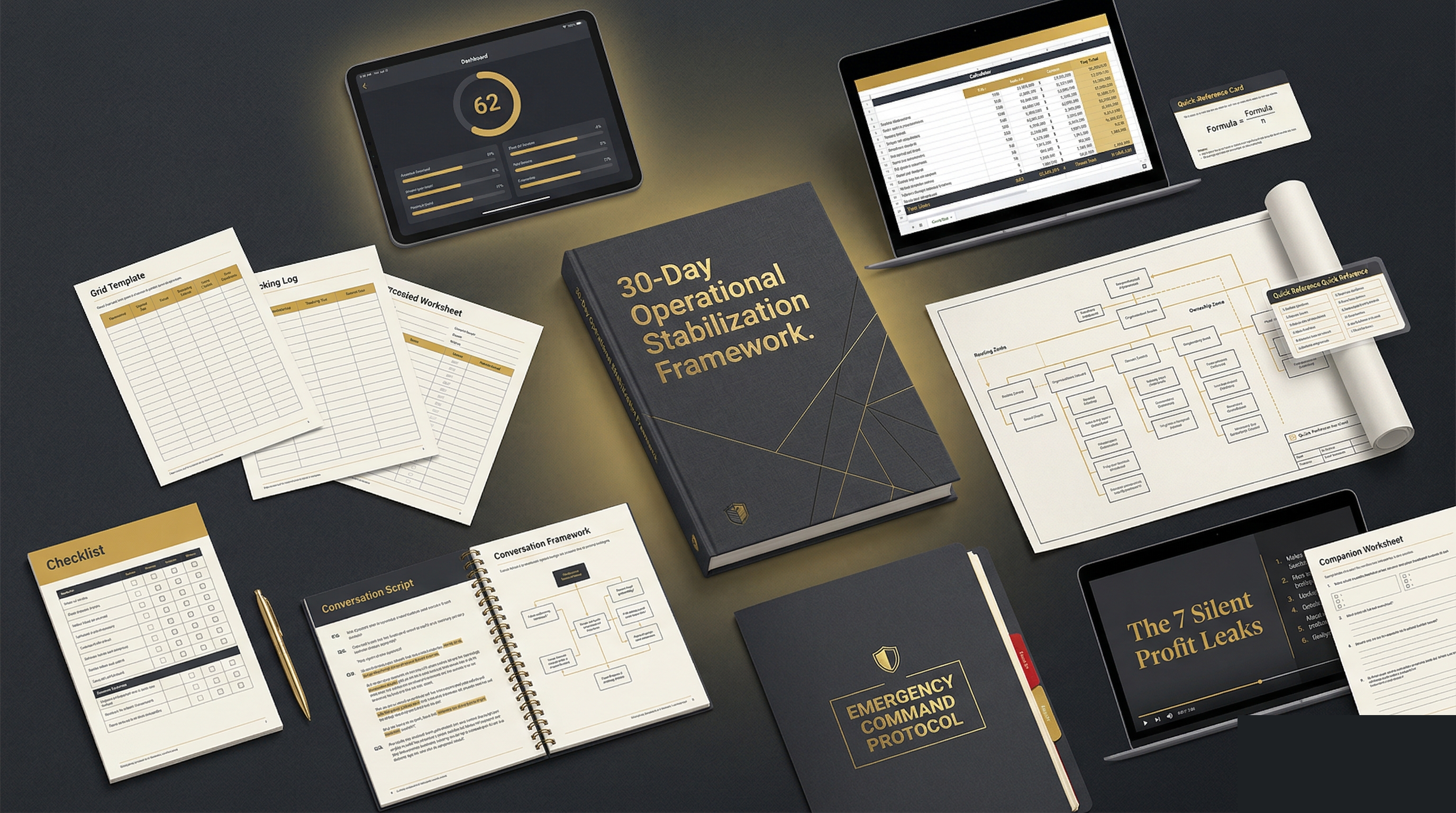
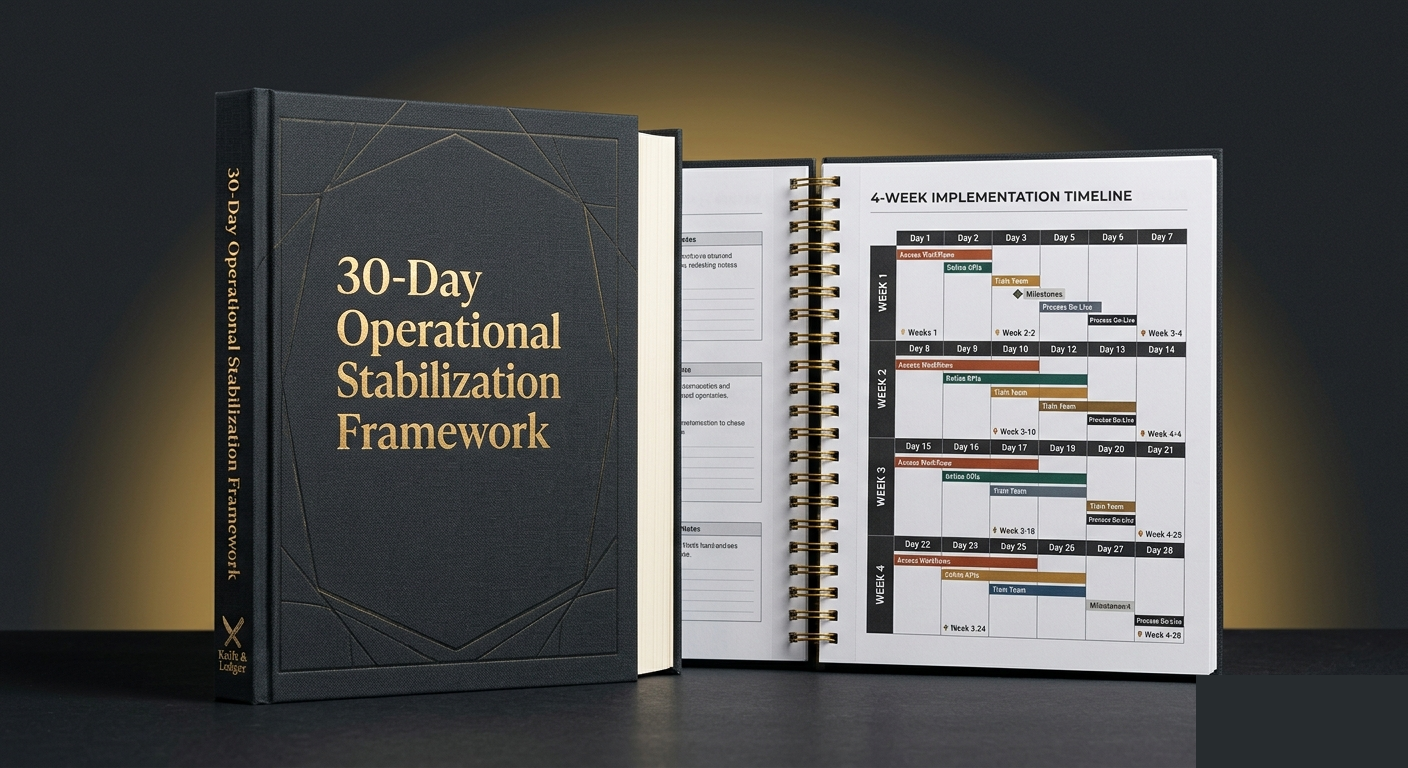
A complete operational architecture program, sequenced across four weekly installations, each packed with lessons, tools, and implementation steps built to deploy inside your existing operation over 30 days. The same four structural failures appear in the same order in virtually every struggling operation.
- Sequenced 30-day implementation roadmap tailored to your operation
- Four structural installations that correct the patterns producing your current numbers
- A repeatable framework you can run again any time the operation needs recalibration
If the core framework was all you got -- the four weekly installations, the sequenced implementation roadmap, and the structural architecture that holds when you're not watching -- it would be worth the investment on its own. This is the same operational sequence that corrected labor, food cost, authority collapse, and financial visibility across every operation it's been installed in. It doesn't need anything else to work.
But I built the Sprint to do more than work. I built it to stick. So I added the tools that close the gaps I watched operators hit after the framework was in place.
Here's What You Also Get When You Enroll Today...
Each bonus was built to solve a specific problem I watched operators carry for years. They're not filler. They're the tools I wished I'd had.
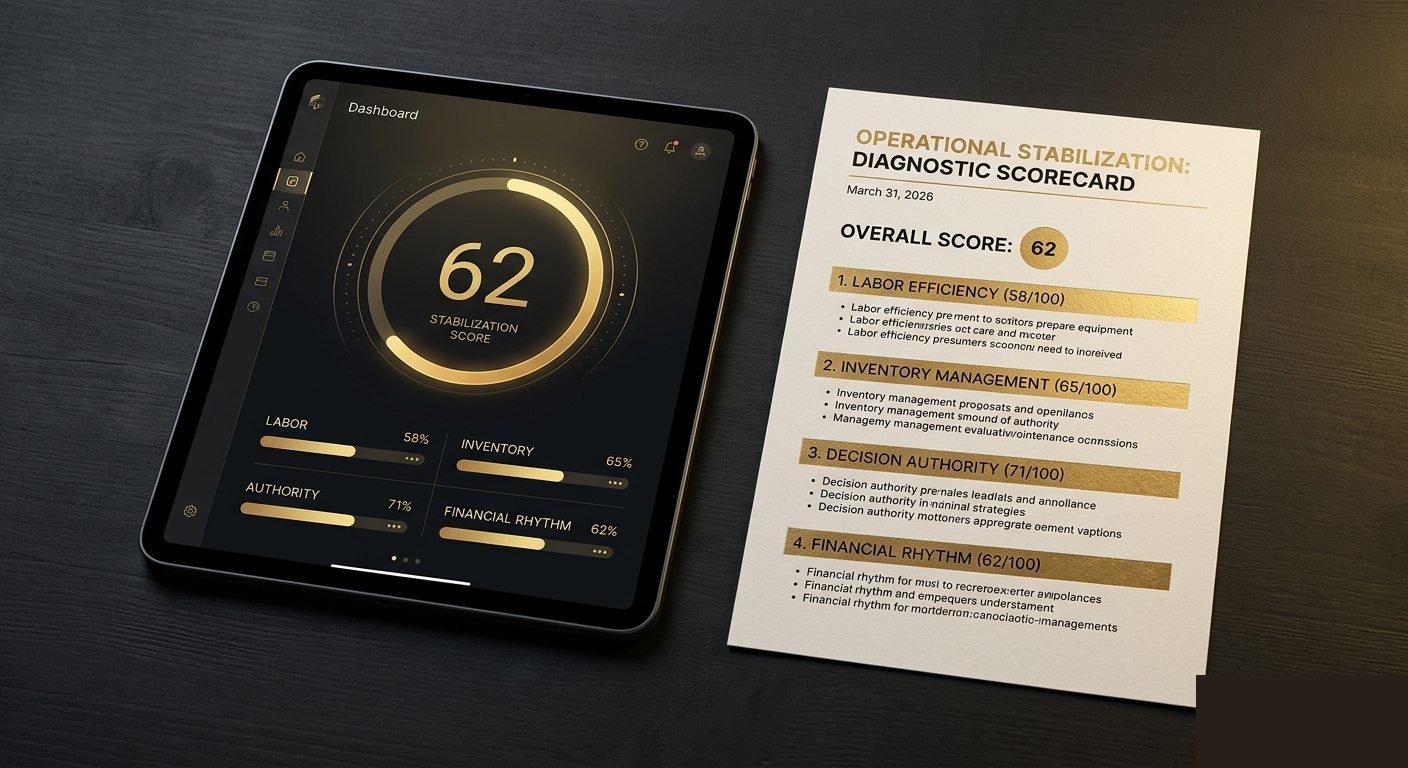
I built this because the operators I was coaching kept saying "I think things are getting better" without any way to prove it. Score your operation on Day 1. Score it again on Day 30. The gap between those two numbers maps directly to cost categories on your P&L.
- Scored baseline across all structural cost categories
- Day 30 re-score showing exactly which numbers moved
- P&L-linked measurement tool you can run quarterly forever
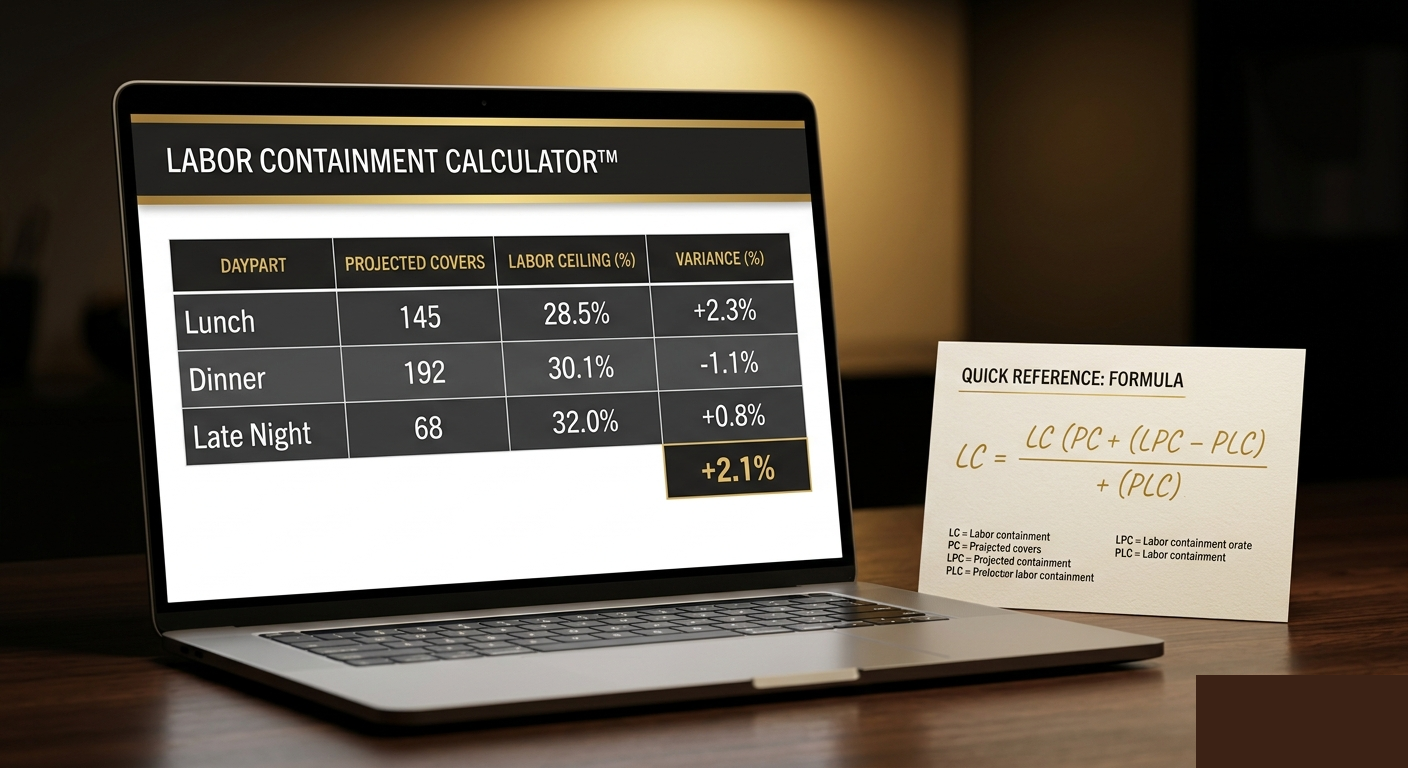
This exists because I watched too many GMs build a "good schedule" and still blow labor by Thursday. Before any scheduling decision gets made, this tool answers one question: at this projected cover count, what's the maximum labor spend that keeps you at or below target?
- Pre-shift labor ceiling calibrated to your cover projections
- Every scheduling decision made from a target, not a feeling
- Labor variance prevented before it hits the P&L
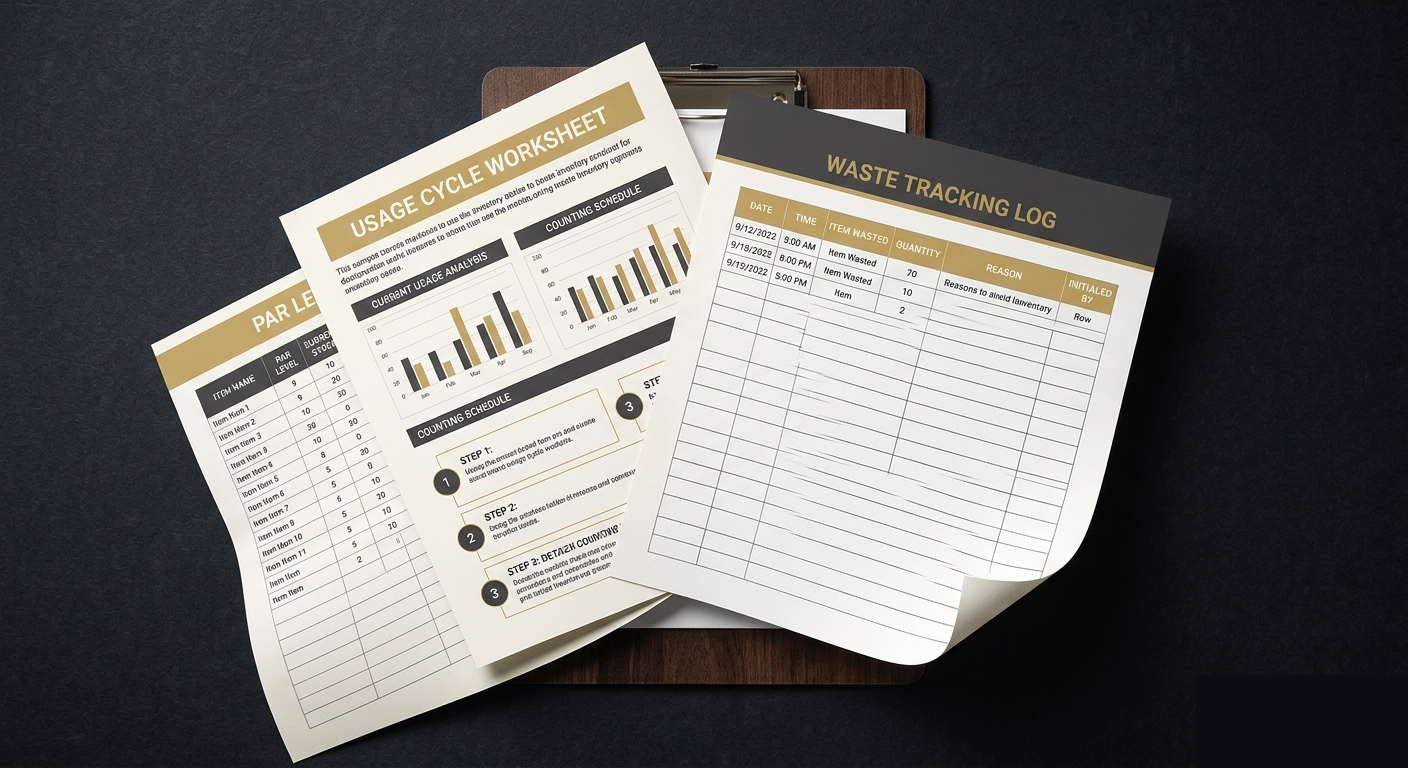
I built this toolkit after watching a kitchen bleed $4,000 a month in food cost and not a single person could tell me where it was going. Food cost doesn't spike. It drifts. A quarter-ounce of over-portioning across 200 covers a day for 30 days is a cost event. It just looks gradual on a monthly report.
- PAR levels built from your actual usage data, not industry averages
- Waste tracking that makes drift visible before it compounds
- The toolkit that corrected food cost from 40% to 30% in 60 days
So far you're getting the 30-Day Framework, the Diagnostic, the Labor Calculator, and the Inventory Toolkit. The four tools that corrected a 10-point labor swing and a 10-point food cost correction in the original turnaround. And we're not done.
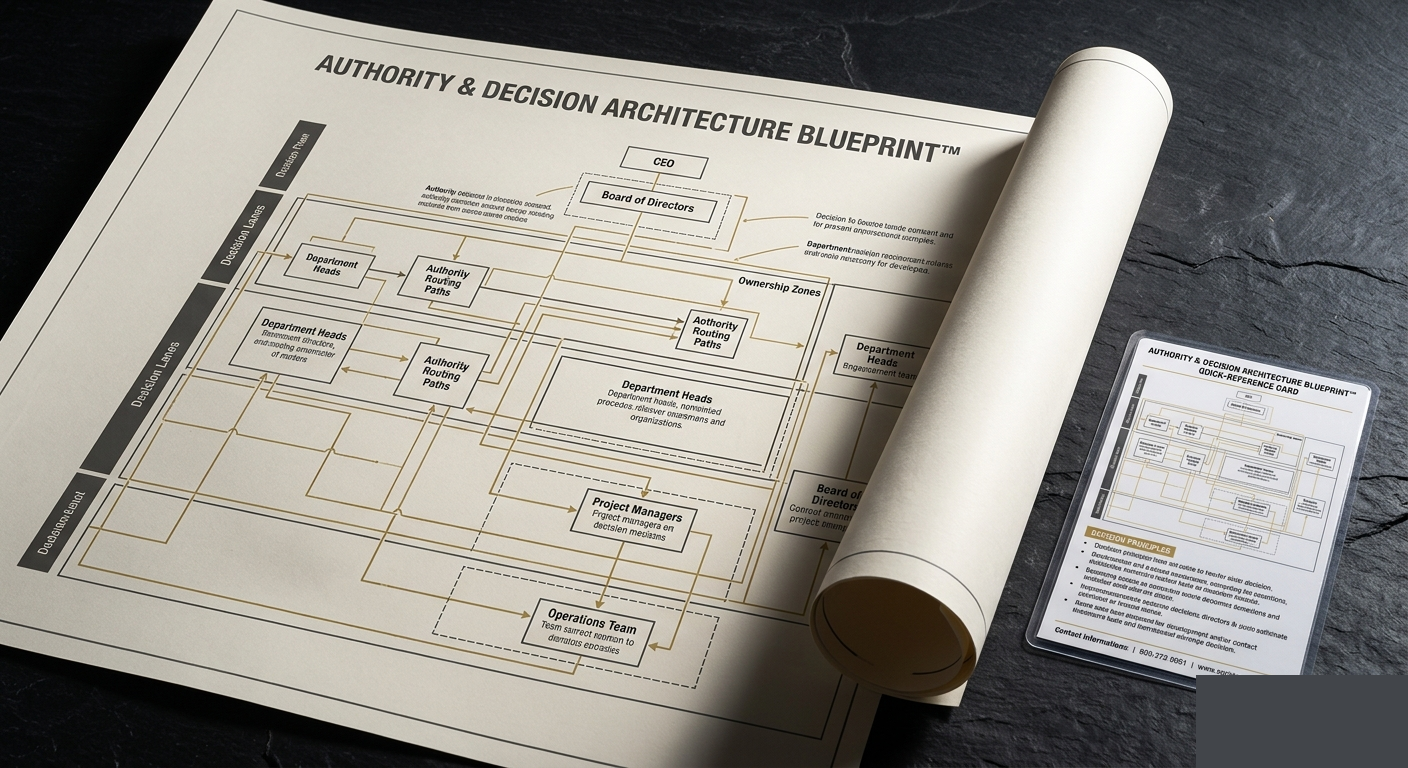
I created this after realizing I was the bottleneck in my own turnaround. The team kept waiting for me because I'd never drawn the line between "my decision" and "yours." Every decision in the building routes through you. Not because your team can't handle it, but because nobody built the ownership lanes that would let them.
- Decision ownership map that stops every question from routing through you
- Clear authority lanes so your team operates without your constant presence
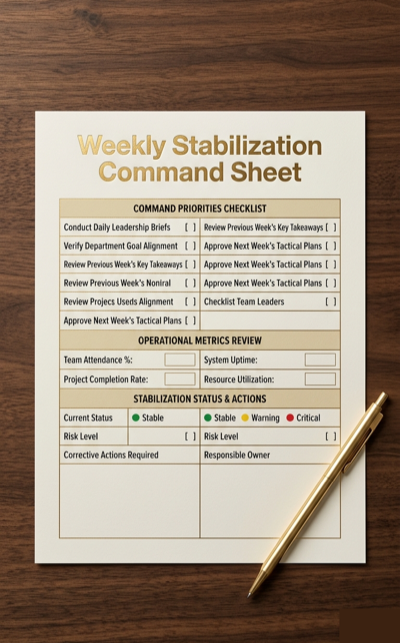
This is the single page I reviewed every Monday morning during the turnarounds. The one that told me whether to relax or intervene before the week got away from me. One page. Every Monday. Twenty minutes. It tells you whether your operation is trending toward drift or holding structure.
- 20-minute Monday ritual that keeps structural gains from drifting
- Early-warning indicators that surface problems before they compound
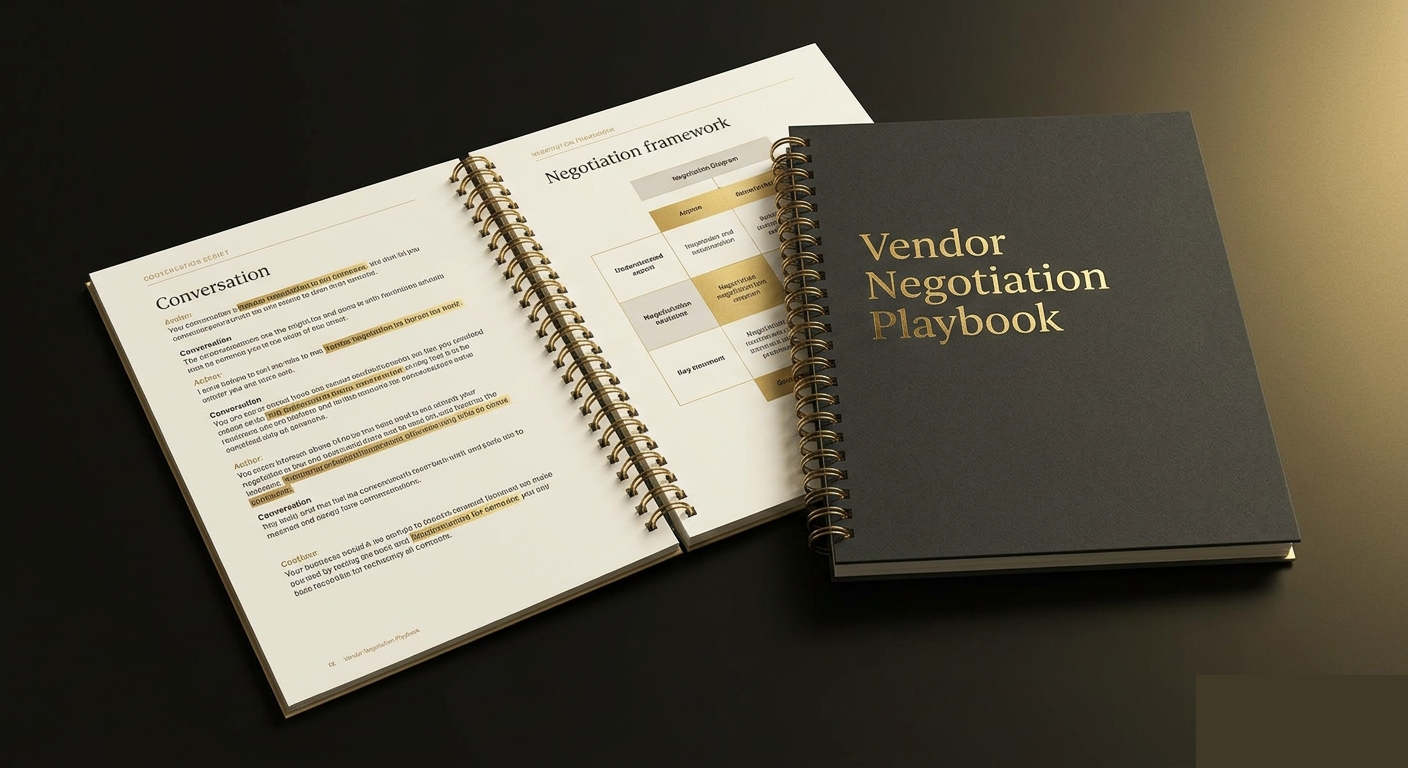
I wrote these scripts after watching a vendor meeting where an operator had no data, no leverage, and no alternative, and still agreed to a price increase. Once you have real PAR data and usage tracking, you have something most operators negotiate without: actual leverage. Most operators recover the full cost of The 30-Day Sprint from one renegotiation.
- Word-for-word scripts for pricing and terms conversations
- Consolidation framework that creates mutual value, not just discounts
- Leverage to negotiate from data instead of from hope
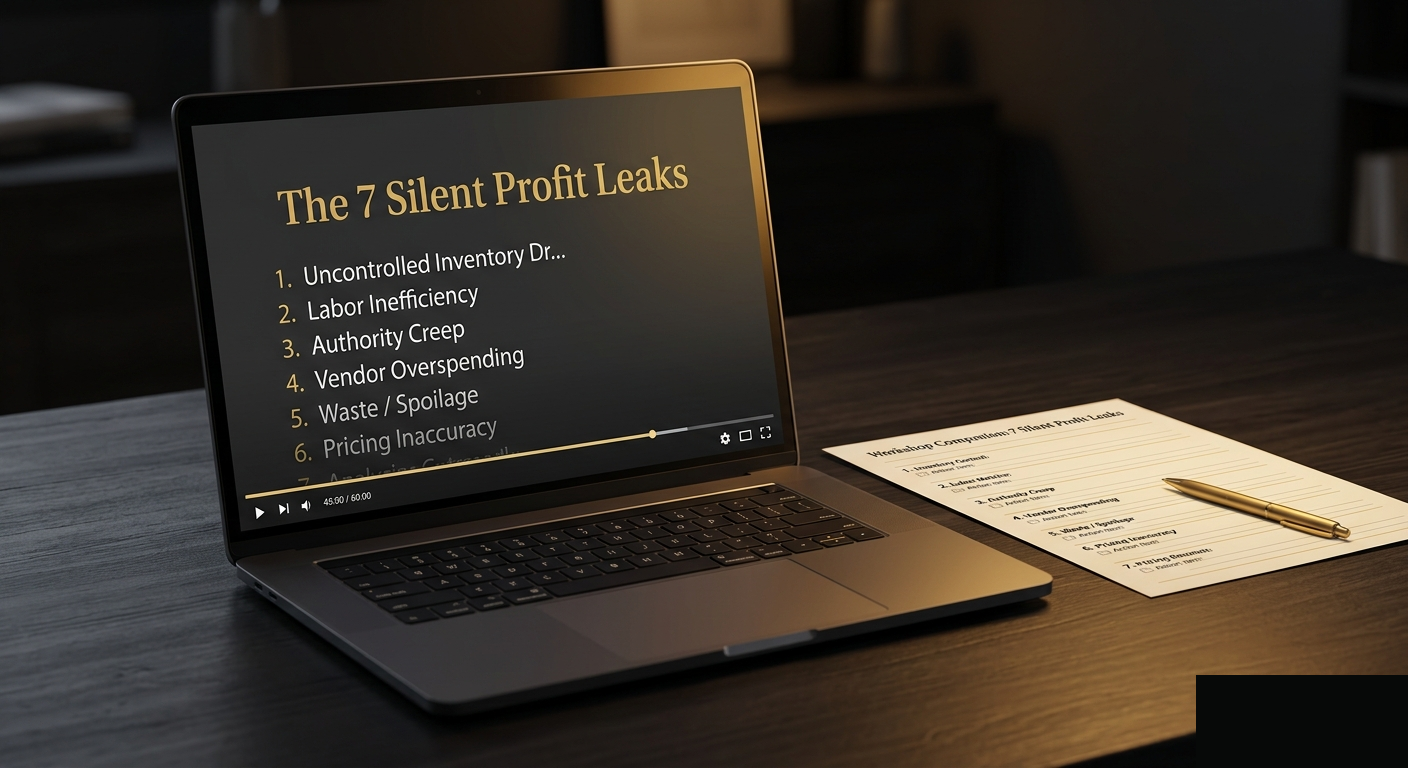
I built this worksheet because too many operators start their first week chasing the wrong leak: going after labor when inventory is the bleed, tightening portions when the real problem is authority gaps letting waste go unreported. It scores all seven silent profit patterns with a diagnostic indicator you can verify inside your operation within 24 hours, so you see exactly which one is costing you the most right now. You start the Sprint with a ranked priority list instead of a guess, and every hour you put in lands on the leak that's actually bleeding you hardest.
- Ranked list of your three most active profit leaks
- Diagnostic indicator for each leak you can verify within 24 hours
- Clear map of which Sprint week closes each one
Let's count it up: the 30-Day Framework, the Diagnostic, the Labor Calculator, the Inventory Toolkit, the Authority Blueprint, the Command Sheet, the Vendor Playbook, and the Profit Leaks Worksheet. Eight components. $3,876 in standalone value. And there's still one more.

I built this after watching an operator lose $8,000 in a single week because a labor crisis hit and they had no protocol. Just panic. A sequenced 72-hour response playbook for when labor explodes, inventory spikes, or cash tightens unexpectedly. Structure instead of panic.
Only available to operators who enroll within 48 hours. Then it's removed from the stack.
- 72-hour playbook for labor spikes, waste events, and cash crunches
- Structural gains that survive the first major test after installation
+ Fast-Action Bonus
Two Locations. Same Chain. Same Format. Both Flagged as Underperformers.
Field Case: The Labor Problem That Wasn't a People Problem
Full-service restaurant in a 60+ unit chain. Suburban Orange County. Steady traffic, experienced staff, no obvious reason to be underperforming. Regional management had flagged it for labor trending high. The instinct was to push harder on accountability and attitude.
What it actually was: schedules built on favoritism instead of demand. No connection between projected covers and how labor was deployed. Management checklists that existed but were not enforced. Servers who had never been shown how their check averages connected to their own income. The standards were there. Nobody was operating inside them.
Scheduling was rebuilt around a demand model with cut thresholds enforced by daypart. Management checklists became accountable. Server coaching focused on disciplined sequencing, not scripted upsells.
corrected
on $2M operation
Field Case: The Walk-In That Was Quietly Bleeding Cash
Different location, similar format. Flagged for declining cleanliness scores and food cost running persistently above target. It looked like a kitchen discipline problem. Sloppy standards, disorganized back of house.
What it actually was: food leaving the kitchen without tickets. Portions unchecked. Waste logs that existed but were not being kept. Prep pars based on habit instead of actual usage. The systems were technically in place. Nobody was operating inside them.
Ticket discipline became non-negotiable. Portions were retrained and spot-checked. Waste logs were kept daily and reviewed weekly with the kitchen team so the cost of drift became visible to the people creating it.
cover improved
on $2M operation
Neither location required a staff overhaul. Both required structural correction.
That is what this Sprint installs.
"If All This Sprint Did Was..."
Think about just one outcome, not all of them, just one, and decide whether that outcome alone justifies the decision.
Any one of those outcomes, on its own, would justify the investment many times over. The 30-Day Sprint doesn't deliver one of them. It's designed to deliver all of them, in sequence, in 30 days.
I Had Two Choices When I Priced This.
I could price it at what it would cost to hire an operational consultant to come into your business, run a full diagnostic, and oversee the first 30 days of implementation. That engagement, done properly, runs between $8,000 and $15,000 for a single-unit operator.
Or I could package the framework, the tools, the diagnostic, and the implementation roadmap into a Sprint that an operator can run inside their own business, with the same sequencing logic and the same outcomes, at a fraction of that investment.
I chose the second option. Because the operators who need this most are the ones who can't afford the first option. And they shouldn't have to.
You're not paying $8,000–$15,000 for a consultant engagement.
You're not paying $1,997 for the core framework alone.
You're not paying $4,173, the full stacked value of everything included.
Instant access · 48-hour fast-action bonus included for next 48 hours
You've Got Two Choices.
Choice #1
Close this page. Go back to your operation. Continue absorbing the structural weight that's been compounding since before you found this page. Six months from now you're in the same conversation, with six more months of margin erosion between now and the fix.
Choice #2
Invest $397. Run a 30-day installation. Find out what your operation looks like when it's structurally sound. Walk into a shift knowing the structure holds whether you're watching or not. Stop doing math on your phone at 11pm. Feel the difference between running an operation and being run by one.
One choice keeps the problem. One closes it.
This Is How I Stand Behind the Work.
This isn't a guarantee. It's a structural fact.
Operators who complete the weekly installs, track their numbers, and follow the recovery protocol when they stall see measurable improvement. The system doesn't fail when it's installed. But this isn't a course you watch and hope things get better on their own. This changes how your restaurant actually runs. Your scheduling changes. Your inventory discipline changes. How you hold your team accountable changes. The way you look at a Tuesday night shift changes.
Old behaviors, old tolerances, looking past the small drains because you're too buried to deal with them -- that's what caused the problems you're living with right now.
The 30-Day Sprint gives you the tools and the targets to build a completely different operational rhythm. The VIP tier puts me in the room to make sure you stay on it. But the action and the discipline have to come from you. No program, ours or anyone else's, will produce the results you want if you slip back into the same patterns that created the pain in the first place.
Everything in the Self-Guided Sprint ($4,173 Value) — PLUS:
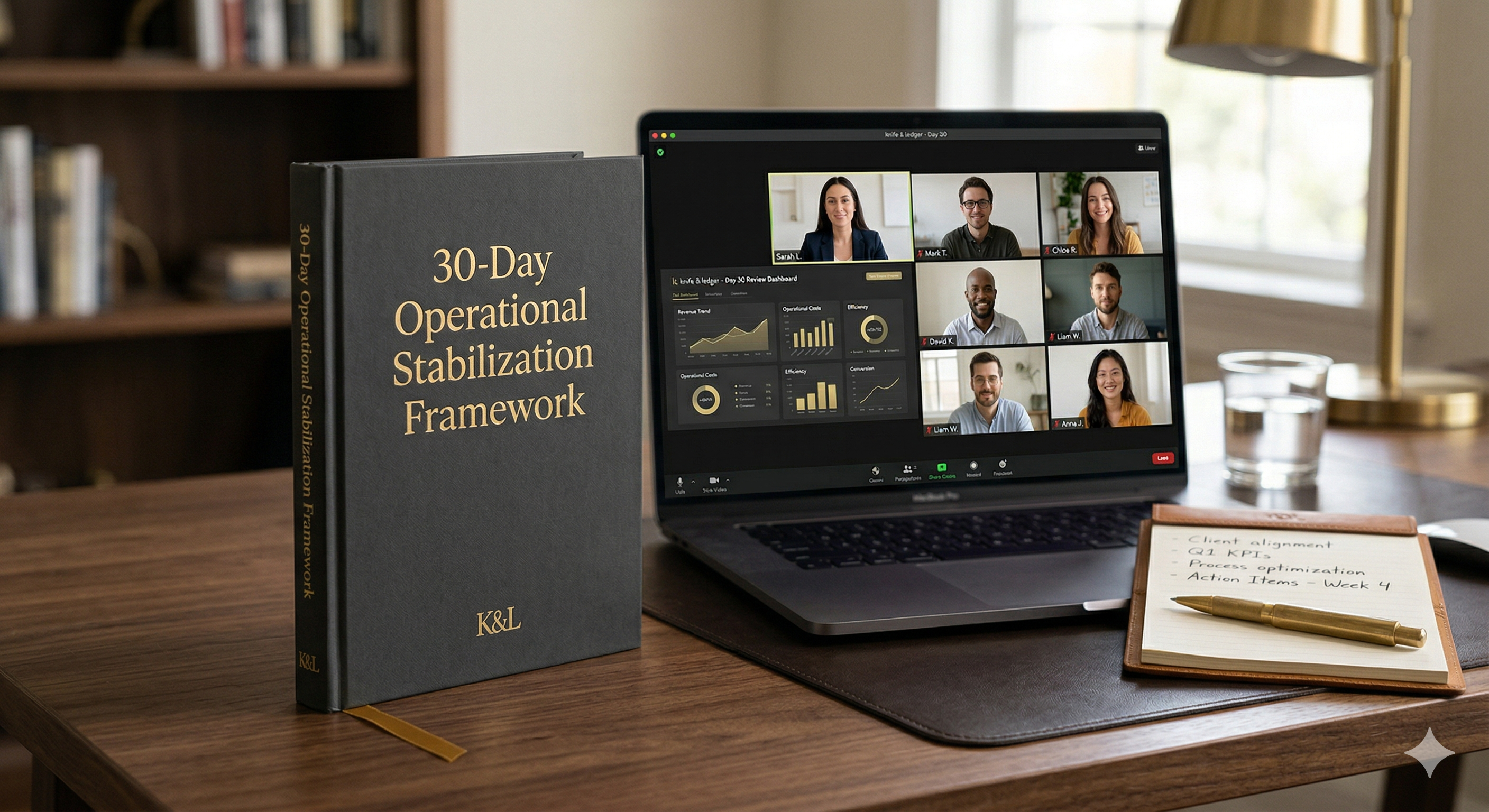
I built these sessions into the VIP track because I watched self-directed operators stall in Week 2 with a friction point they couldn't diagnose on their own. They didn't need more content. They needed someone who'd already seen the pattern to tell them what to clear and what to leave alone.
Four live 60-minute Zoom sessions, one per week, aligned to each installation. Structured review of your implementation progress. Real-time identification of friction points. Course correction before the next week begins. These aren't Q&A sessions. They're board-level operational reviews, the same structured rhythm I used to drive accountability in the turnarounds, applied to your Sprint implementation.
Every session recorded and archived in your Command Center.
- Weekly course correction before the next installation begins
- Friction points identified and cleared in real time, not after the damage compounds
- The same accountability rhythm that drove results in the turnarounds, applied to your Sprint
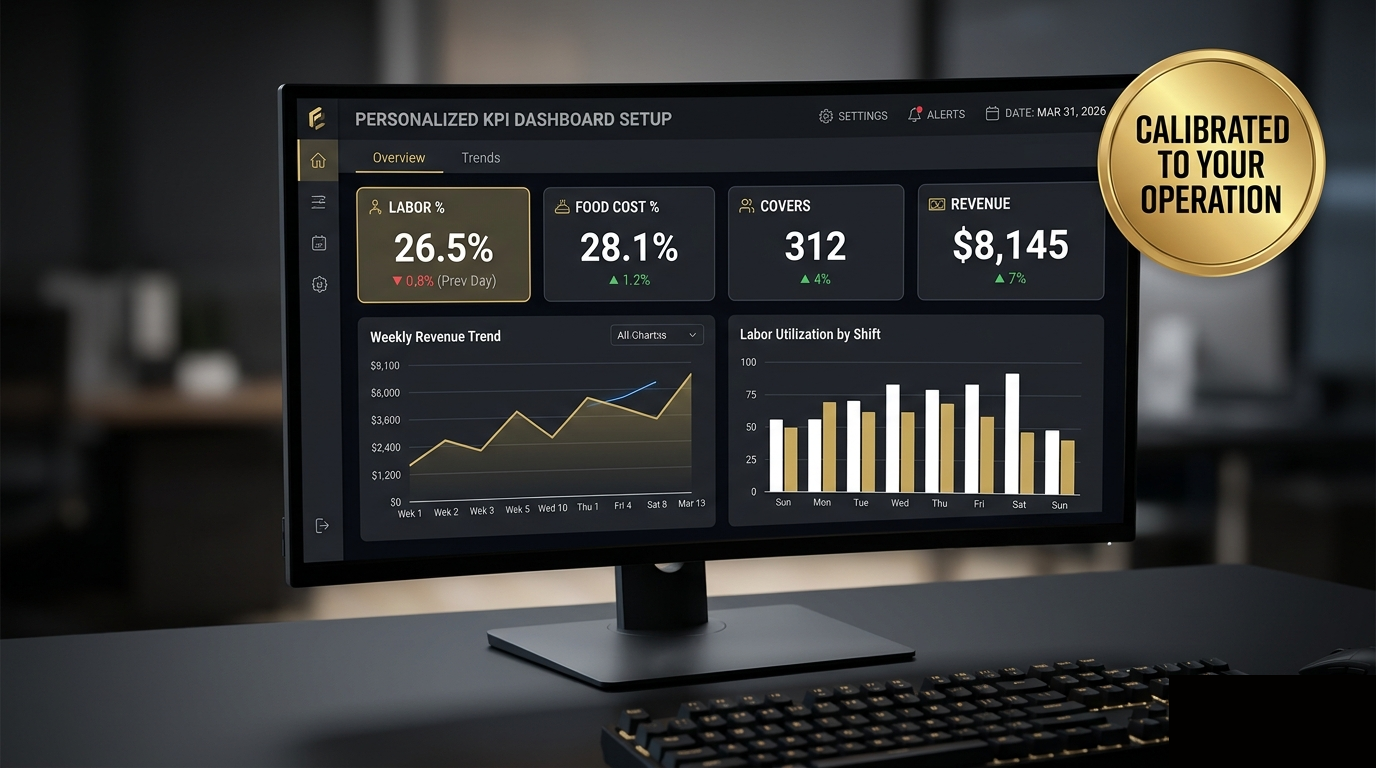
This exists because generic industry benchmarks don't match your operation. A 32% labor target means nothing if your format, daypart mix, and service model put your real threshold at 28%. Before Week 1 begins, we review your numbers and build a dashboard around your actual revenue, labor, and food cost baselines, so everything you track during the Sprint reflects your restaurant, not someone else's averages. You spend 30 days measuring against targets that are actually yours, which means when a number moves you know exactly what it's telling you and what to do next.
- Dashboard calibrated to your actual revenue, labor, and food cost baselines
- Thresholds and leading indicators set from your operation's data, not industry averages
- A single-screen view of whether you're trending toward drift or holding structure
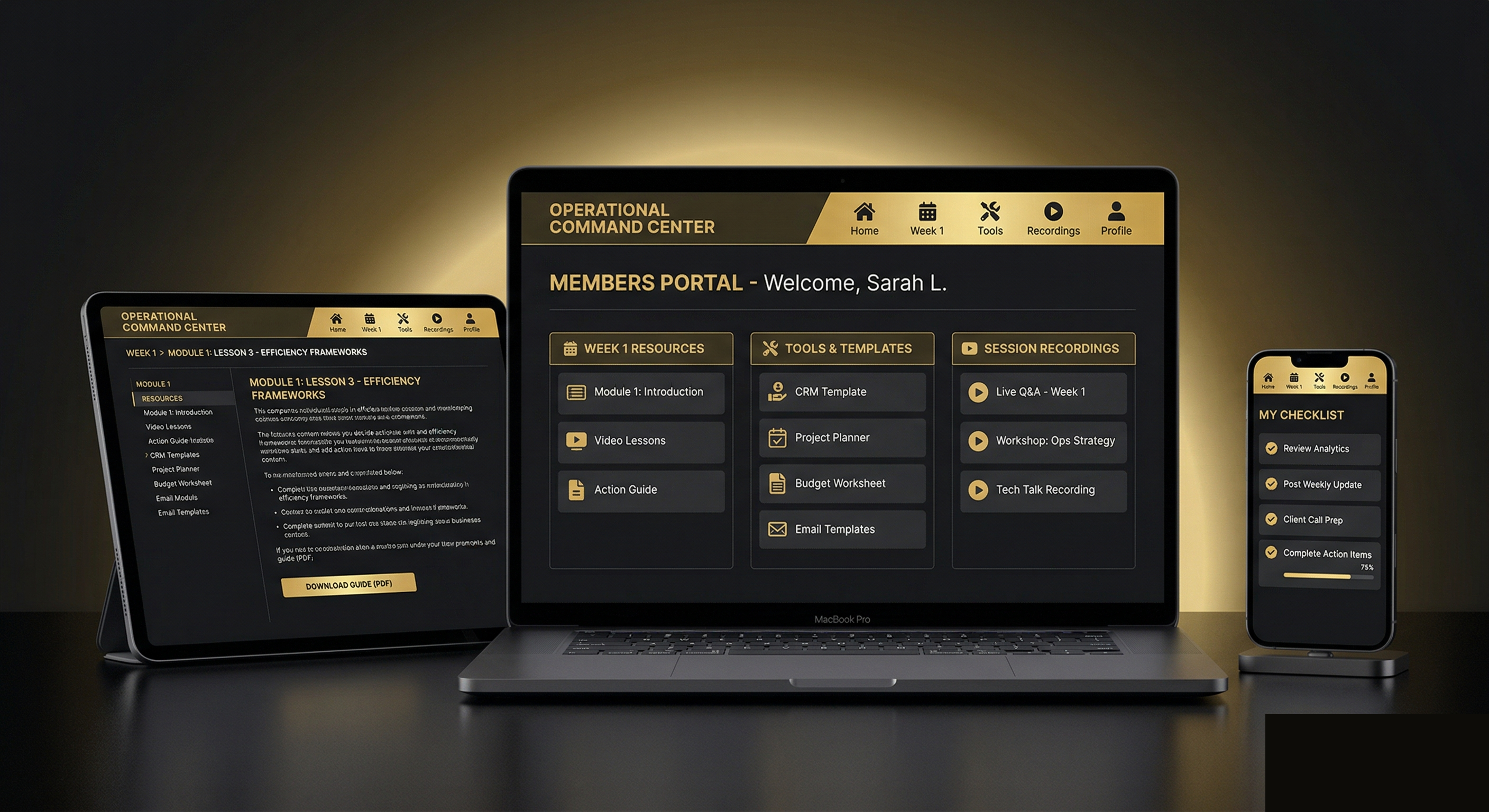
The tools don't work if you can't find them when you need them. I've watched operators stall a full week because a resource was buried in a subfolder they forgot existed. Every tool, recording, template, and resource is organized by function, Sprint week, and decision type, so the right thing is one click away no matter where you are in the process. You don't lose days hunting for files, which means the 30-day timeline stays intact and every installation builds on the last one without interruption.
- Every Sprint resource organized by function, week, and decision type
- Board session recordings archived and searchable by topic
- Permanent access that doesn't expire when the Sprint ends
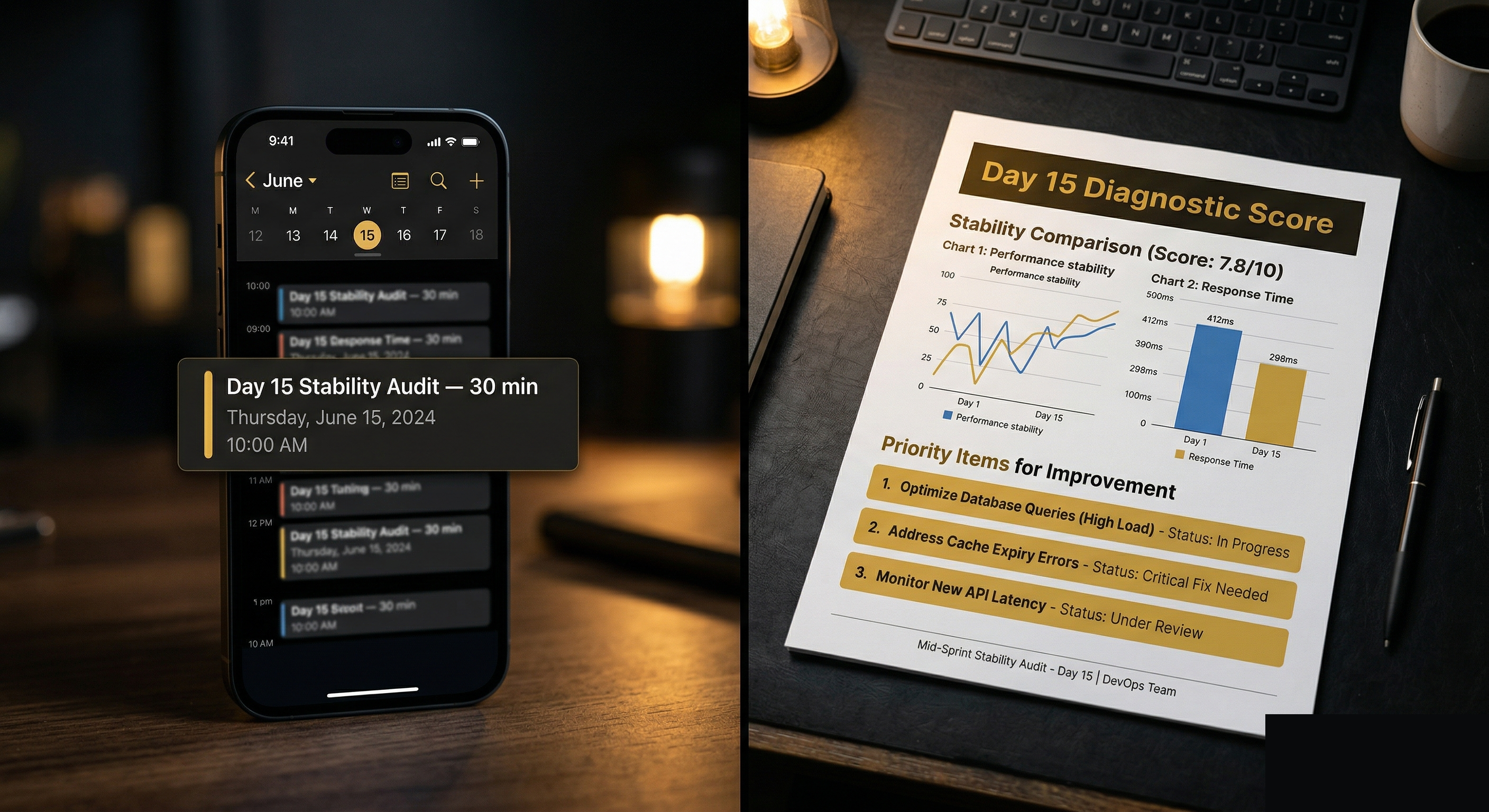
The pattern repeats in almost every self-guided Sprint: operators finish Week 2 feeling good, then hit Week 3 with something off they didn't catch, and by Week 4 the compounding has cost them the momentum from the first half. At Day 15 you get a diagnostic re-score, a clear picture of where your installation stands, and a specific correction plan for Weeks 3 and 4. You go into the second half knowing exactly where you are instead of guessing. That's the difference between a Sprint that produces real change and one that loses steam.
- Day 15 diagnostic re-score showing exactly what moved in the first two weeks
- Specific course correction directive for Weeks 3-4 based on your implementation data
- The inflection-point catch that prevents first-half misalignment from compounding
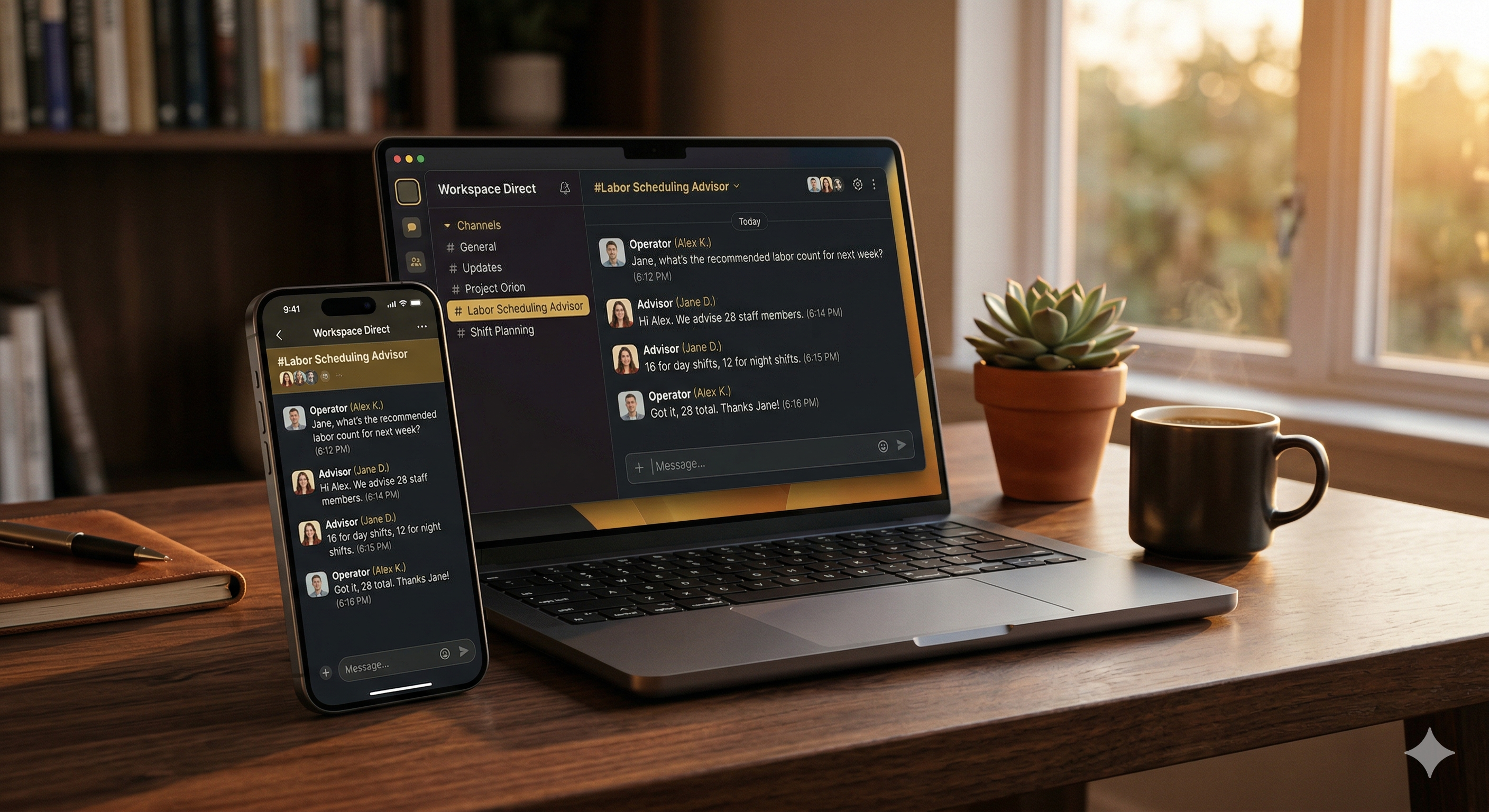
The real questions don't come up during business hours. They come up at 11pm on a Tuesday when you're reviewing tomorrow's labor deployment and something doesn't add up, and without a direct channel most operators sit with that question for days. A private Slack channel gives you direct access Monday through Friday with a one-business-day response window, so the kinds of problems that would normally stall you for a week get cleared in hours. You keep moving through the entire 30 days instead of losing time to uncertainty.
- Direct access to Greg for real-time implementation questions, Monday through Friday
- Answers that clear friction points in hours instead of days
- 30 days of support timed to the exact window where questions matter most
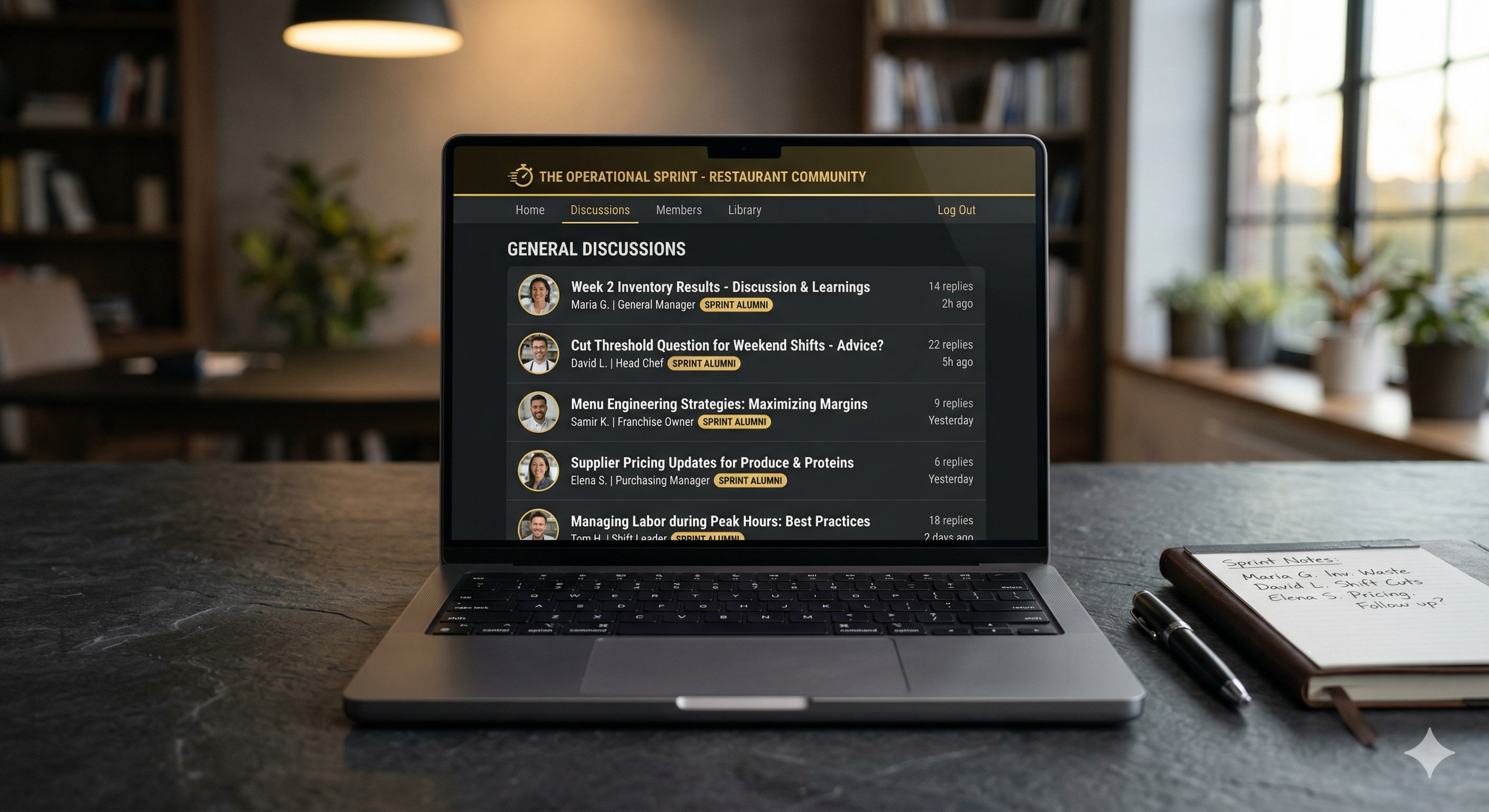
The loneliest part of running a restaurant isn't the hours. It's having no one who understands the problem at the operational level, where your friends see a busy dining room and assume things are great and your accountant sees the numbers but not the building. Every member has completed the Sprint methodology and worked through the same challenges, so when you post a question the responses come from operators who've solved that exact problem using the same framework. You get a permanent peer group that actually speaks your language. People who've been where you are and can tell you what worked.
- Peer network filtered by methodology completion, not payment
- Answers from operators who've navigated the same structural friction points
- A room where the operational conversation actually matches the operational reality
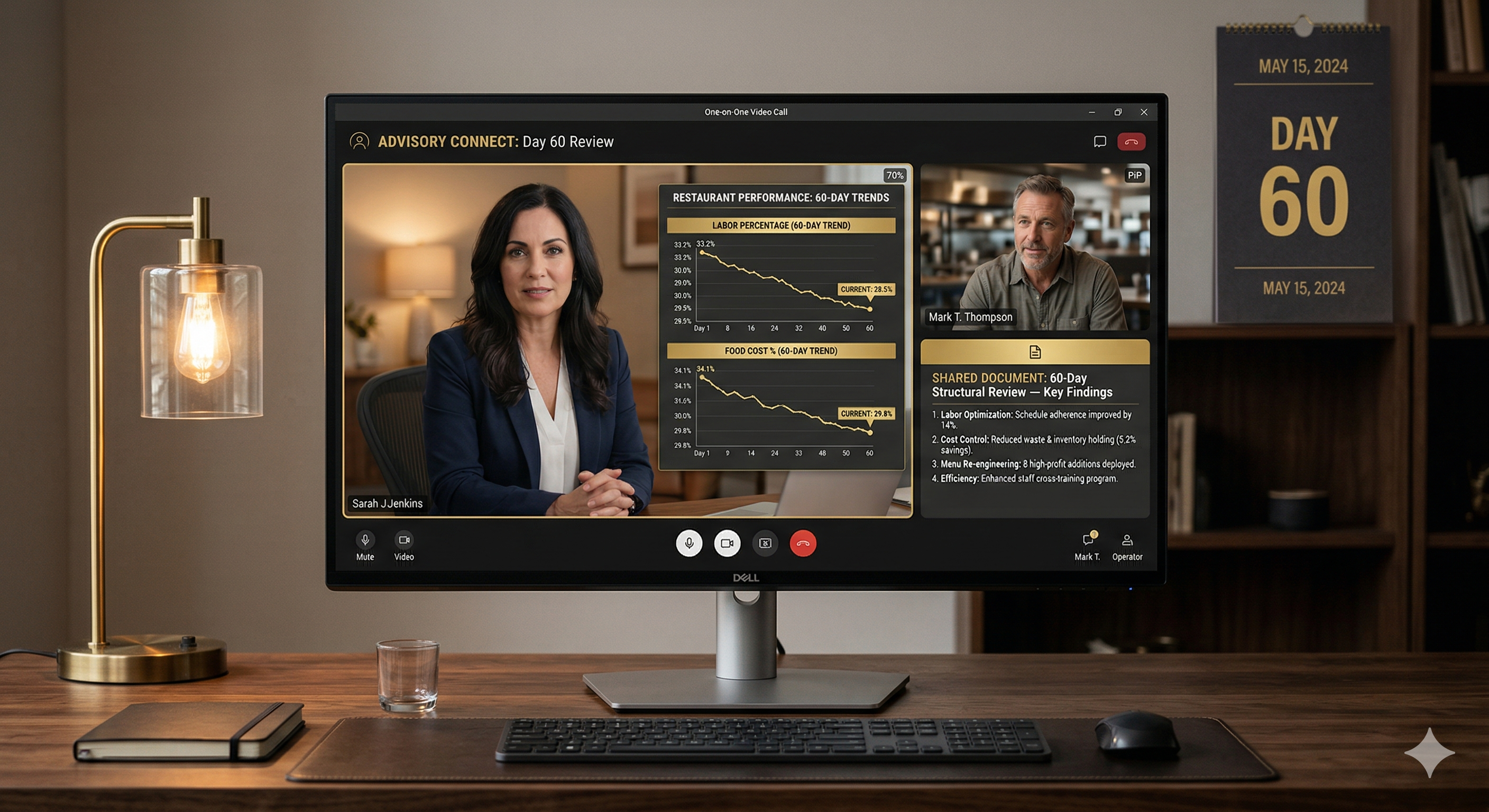
Day 30 isn't the real test. Day 60 is, and somewhere around Day 45, without anyone watching, the old tolerances start creeping back in. Not because you failed, but because standards without accountability drift back to default. A 60-minute session reviews what's holding, what's drifted, and where the first real maintenance challenge showed up, giving you a clear plan for the next 90 days. You catch the drift before it settles back in, which is what turns a strong 30-day Sprint into a permanent change instead of a temporary one.
- Honest audit of which installations held and which are drifting
- Specific corrections to lock in gains before old patterns re-anchor
- A 90-day maintenance directive so the structural change becomes permanent
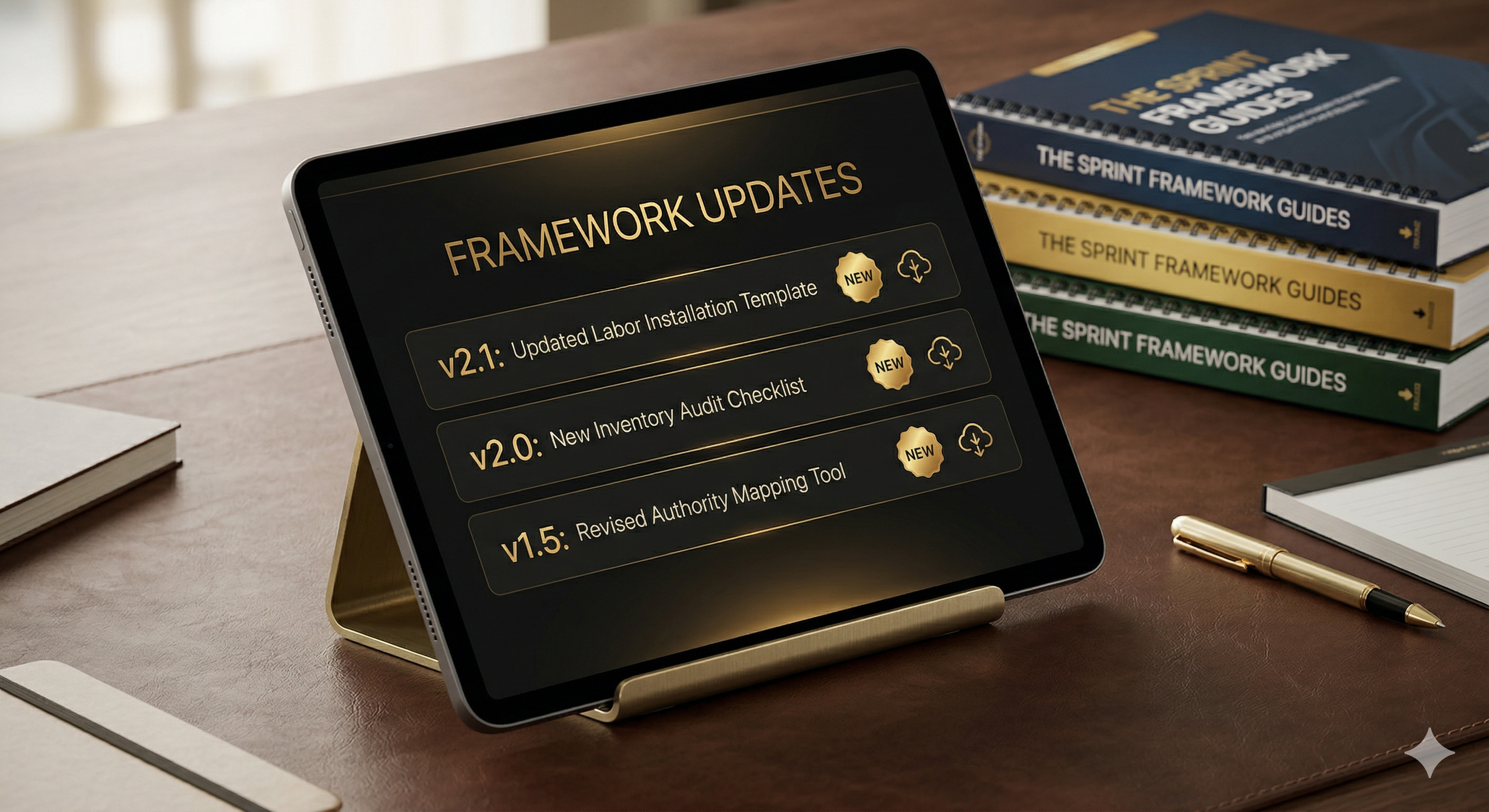
The framework evolves with every cohort: each group surfaces something new about where operators stall, what accelerates results, and which tools need refinement. As the Sprint improves, every new tool, refined installation, and updated template lands in your Command Center automatically at no additional cost. Your investment gets sharper over time instead of going stale. The framework you're running a year from now will be better than the one you started with.
- Every framework update, new tool, and refined template delivered automatically
- No re-enrollment, no upgrade tier, no additional cost
- A Sprint investment that appreciates in value over time instead of going stale
That's everything. The complete Self-Guided Sprint framework plus eight VIP components built to ensure every installation holds: live board sessions, personalized KPI setup, a Command Center, a Day 15 audit call, direct Slack access, a peer operator network, a 60-day check-in, and lifetime updates. $10,061 in standalone value. Here's what it looks like together.

"If All the Cohort Did Was..."
The price difference between the self-guided path and the VIP Cohort isn't about more content. You're getting the same framework either way. It's about the infrastructure that makes the framework stick: the accountability, the course correction, the peer context, and the direct access that turns a 30-day program into a permanent structural change.
What This Would Cost Any Other Way.
Four one-on-one implementation coaching sessions with an experienced operational advisor: $2,000 minimum.
A mid-sprint diagnostic and course correction call: $500. Thirty days of direct advisory access via any channel: $997 at absolute minimum. Post-sprint follow-up and 60-day structural review: $500.
Add the self-guided Sprint stack ($4,173 value) and you're at $8,170 before the KPI setup, the Command Center, the network access, or the lifetime updates.
Now and Later.
Your Operation Now
Labor variance managed by feel. Food cost that drifts between counts. A decision structure that routes every exception back through you. A P&L that reports instability you don't yet have the visibility to see in real time.
Your Operation After the VIP Cohort
Four structural installations, verified by an expert at each transition. A diagnostic showing the measurable gap closed. A peer network running the same methodology. The 11pm margin calculations? Stopped. You take a day off and nothing breaks. You walk into Monday morning feeling like the owner of a business instead of the hostage of one.
The distance between those two states is 30 days and the decision you make right now.
Say Goodbye.
When you enroll in the VIP Cohort, here's what you leave behind:
All of it is structural. All of it is correctable. All of it closes in 30 days with the right installation.
20 founding seats · Founding price locked permanently · Cohort begins immediately
The first 20 operators to join are the Founding Stabilization Class. Four cohorts of five operators each, every session led personally by Greg. Your founding price of $997 is locked permanently. Future cohorts open at $1,497. You receive first right of access to the advanced Operational Mastery program before it's announced publicly. Founding status is noted, permanent, and non-transferable.
You've Got Two Choices.
You can take the self-guided path. It's a strong path. The framework is the same, the tools are the same.
Or you can take the VIP path, with expert eyes on your implementation at every transition, a peer group running the same race, and the infrastructure that turns a 30-day program into permanent structural change.
Or, you can choose to do nothing and remain where you are now. The same broken structure, the same drift eating away at your profits, and the same chain tying your life to your operation.
The self-guided Sprint closes the gap. The VIP Cohort closes it and makes sure it stays closed.
Let Me Break the Last Excuse.
If You Leave Today Without Acting, Nothing Changes.
I mean that literally, not as a motivational statement.
The structural patterns producing your current results were in place before you found this page. They'll be in place after you close it. The same drift. The same variance. The same conversations about why the numbers aren't reflecting the effort.
You Don't Need to Be Ready. You Need to Be Willing.
The operators I've watched run this framework weren't the most analytically sophisticated. They weren't the best capitalized. They weren't the ones with the cleanest operations going in.
They were the ones willing to look at what was actually happening and install the structure that would hold when they weren't watching.
The Belief That Keeps You Stuck Longest.
"If I just work harder, this will eventually correct itself."
It won't. Effort without structure doesn't produce proportional results. It produces exhaustion that looks like commitment. The operators who run the hardest are often the ones with the widest structural gaps, because their effort masks the drift.
Six Months From Now.
Version one: you close this page. Drift compounds. Six months from now you're in the same place, with six more months of margin erosion between now and the fix.
Version two: you enroll today. Command clarity installs in Week 1. Labor corrects in Week 2. Inventory tightens in Week 3. Full visibility and review rhythm lock in by Week 4. The 11pm margin calculations have stopped.
Both versions start with the decision you make in the next few minutes.
The Complete 30-Day Sprint Stack — Self-Guided & VIP
Two Paths. One Decision. Right Now.
$4,173 Total Value · One-time investment
Instant access
$10,061 Total Value · Founding seat locked
Price increases to $1,497 when seats fill